
How to Combine Print and Digital Marketing for Real Results
How do I combine print and digital marketing for my business? It's a question more owners are asking as they watch their print budgets and digital campaigns run in parallel without reinforcing each other. Many small businesses treat print and digital as two separate budgets that never talk to each other. The print shop delivers business cards. The web designer builds a website. A Google Ads agency runs campaigns. Nobody connects them, so the customer journey has gaps you're paying for and not seeing. When you combine print and digital marketing intentionally, response rates jump by as much as 63% compared to using either channel alone, a figure supported by industry benchmarks from sources including Postalytics and the Data & Marketing Association. A rack card becomes a traffic driver. A business card becomes a lead capture tool. Signage drives Google searches. The mechanics aren't complicated; they just require someone to plan the connection before anything goes to print. This guide walks you through how to link your physical materials to your digital campaigns, set up tracking, and build a workflow that moves people from a printed piece to a conversion, which is exactly the kind of cross-channel marketing Superior Effect Marketing was built to support
Why print and digital perform better together
Standalone direct mail averages a 3.6, 4.4% response rate, according to DMA benchmarks. Add coordinated digital channels, email follow-ups, social retargeting, and paid search, to the same campaign and that number climbs to 7% or higher, a 63% lift documented in integrated campaign research. For house lists (people who already know your business), integrated campaigns can push response rates to 6, 10% or higher. For more on improving those direct mail response rates, industry guides offer practical tactics.The conversion side is even stronger. Direct mail converts about 14% of responders into customers, compared to 1.9% for email alone. When print warms the audience and digital closes it, you're working with the strengths of both channels instead of the limits of one. That's not a small difference; it's the gap between a campaign that pays for itself and one that doesn't.Your customers don't stay in one place. Someone picks up your rack card at a hotel front desk, scans the QR code on their phone, browses your website, sees your retargeting ad on Instagram three days later, and books. That multi-step journey is completely normal in omnichannel marketing. The businesses that win are the ones who plan for it instead of hoping each channel works independently.
The print materials worth connecting to your digital campaigns
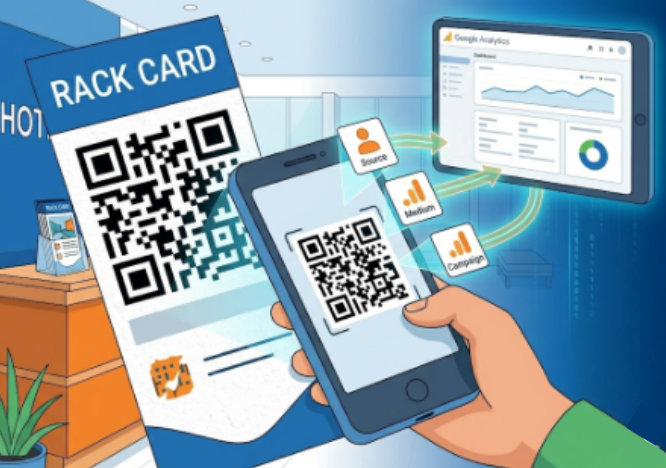
A rack card without a digital connection is a one-way conversation. Add a QR code that links to a dedicated landing page and you've turned even a low-cost printed piece into a trackable lead-generation tool. The same logic applies to business cards: a QR code that goes to a contact form, a booking page, or a special offer converts a handshake into a measurable action.The key is specificity. The QR code on your rack card shouldn't go to your homepage. It should go to a page built for that exact offer or location, so the visitor's experience matches what the printed piece promised. When there's a mismatch between what the print says and where the digital goes, people leave immediately.Direct mail gives you physical presence in someone's home or office. When that mailer includes a short URL or QR code tied to a landing page, a promo code, or an email opt-in, you're extending the conversation beyond the mailbox. In-store signage works the same way: a window sign or table tent with a scannable code can drive foot traffic to a loyalty program, a review page, or a social follow. Both formats work best when the print piece and the digital destination are designed together, not handed off to separate vendors who've never spoken.
How to use QR codes, PURLs, and short URLs to bridge the gap
QR codes in optimized print campaigns achieve scan rates as high as 67%, and pairing a QR code with a short URL on the same piece boosts engagement by 156% compared to using either alone, based on 2024, 2025 QR adoption research. Those numbers only matter if you're tracking them. Follow established best practices for designing a QR code landing page so scans turn into measurable actions.
Setting up dynamic QR codes and UTM tracking
Use dynamic QR codes rather than static ones so you can update the destination URL without reprinting your materials. Industry data shows dynamic codes are now the recommended standard for print campaigns. Link each code to a UTM-tagged URL so Google Analytics 4 captures the traffic source accurately. A basic UTM string looks like this: . This tells you exactly which printed piece drove each visit, the only way to prove your print budget is working. For implementation details on GA4 UTM tracking codes, technical guides can help you standardize naming conventions.
When to use PURLs and short URLs
Personalized URLs, or PURLs, are unique links generated for each recipient (for example, ), used most often in direct mail campaigns. They land visitors on a page that reflects their name or specific interests, which reduces friction and increases conversions. Short URLs are the right choice when someone needs to type the link manually, such as on a billboard or a poster where scanning isn't practical. For most small business print materials, a dynamic QR code with UTM tracking is the simplest and most effective starting point. Read more about how PURLs and personalized QR codes can lift response and conversions.
A practical workflow for your first integrated campaign
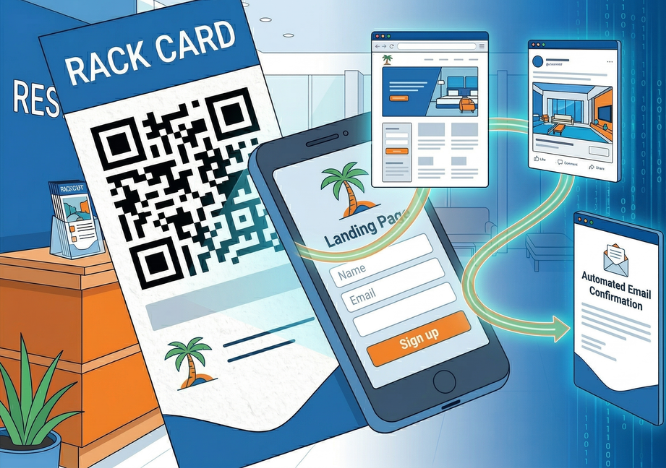
Here's a real-world sequence that works. A resort prints rack cards for distribution at regional visitor centers. Each card features a QR code linking to a seasonal offer landing page. The landing page captures an email address in exchange for a discount code. Clean, direct, and completely trackable from the first scan.From that form submission, an automated email sequence fires: a confirmation email immediately, a follow-up with trip planning tips at day three, and a last-chance offer at day seven. The print piece started a conversation that digital carried to a close. Total planning time runs six to eight weeks from concept to distribution, with print and digital assets designed in parallel so nothing is mismatched when the campaign ships.
Adding retargeting to close the loop
Not every visitor converts on the first visit, and that's where retargeting fills the gap. Set up a retargeting audience in Facebook Ads Manager or Google Ads that captures anyone who visited your landing page but didn't submit the form. Serve them a follow-up ad with a slightly different angle or a stronger offer. For direct mail campaigns, a common best practice is to trigger a Facebook retargeting campaign to a matched audience list three to five days after mail delivery. Coordinated timing is what separates a campaign from a collection of disconnected materials.
Tracking conversions from print so you know what's working
Attribution is the part many small businesses skip, and it's the reason they can't justify print budgets. The fix is straightforward: every print piece gets its own tracking identifier. UTM parameters handle this for digital destinations. Promo codes handle it for in-store or phone redemptions. Vanity URLs like work when a QR code isn't practical. Set each identifier up before your materials go to print.If you're tracking phone calls, use a call tracking number from a tool like CallRail so call volume from print is captured separately from organic traffic. Without a dedicated number, you have no way of knowing whether a call came from your postcard, your Google listing, or a word-of-mouth referral, and that ambiguity makes budget decisions a guess.Benchmark your campaign against realistic targets. For cold-list integrated campaigns, a 3, 6% response rate is solid. For house lists, 6, 10% or higher is achievable. From those responders, industry data suggests expecting 10, 20% to convert into customers for most B2C businesses. Track cost per lead, cost per acquisition, and return on ad spend across both channels together, not separately. As an illustration: a rack card that costs $150 to print and distribute but generates eight form submissions against a significant average job value is a strong performer regardless of what digital analytics show in isolation. Results will vary by industry, but the principle holds.
The hidden cost of running print and digital through separate vendors
Brand inconsistency is one of the most overlooked conversion killers. When your printer uses a different shade of blue than your web designer, when the headline on your rack card doesn't match the language on the landing page it links to, or when your social ads use a tone that contradicts your printed flyers, customers sense the disconnect even if they can't name it.This happens most often when print and digital are handled by separate vendors who've never seen each other's work. Each vendor optimizes for their piece of the puzzle, but nobody owns the customer journey as a whole. You end up paying for coordination problems in the form of lower conversion rates and brand confusion that compounds over time. This is the core argument for true omnichannel marketing managed under one strategy.Working with an agency that handles both print production and digital marketing in-house addresses this coordination problem by design. Superior Effect Marketing builds print collateral and digital campaigns from the same brand foundation, same fonts, same tone, same messaging hierarchy. When the team designs a rack card and the landing page it points to, those two assets are built together by people working from the same brief. That consistency isn't cosmetic. Visitors who arrive via a print piece expect to land somewhere that feels like a continuation of what they just held in their hands. When it doesn't match, they leave.
Start with one sequence and build from there
If you're asking how to combine print and digital marketing for your business, the answer isn't to do everything at once. Start with one print piece: a rack card, a direct mail postcard, or a business card. Add a QR code linked to a dedicated, tracked landing page. Set up UTM parameters so you can see the traffic in GA4. Then add an email follow-up or a retargeting ad to extend the conversation.Do that once, measure it, and build from there. The businesses that struggle with integrated marketing usually try to launch every channel simultaneously. The ones that get results pick a single print-to-digital sequence, optimize it until it converts, and then expand. The data you collect from that first campaign tells you exactly where to invest next.If you want your print and digital assets developed under one roof, so the branding, messaging, and tracking work together from day one, Superior Effect Marketing handles both sides in-house. Reach out to see how a connected campaign could work for your business